
 Skip to content
 July 6, 2026
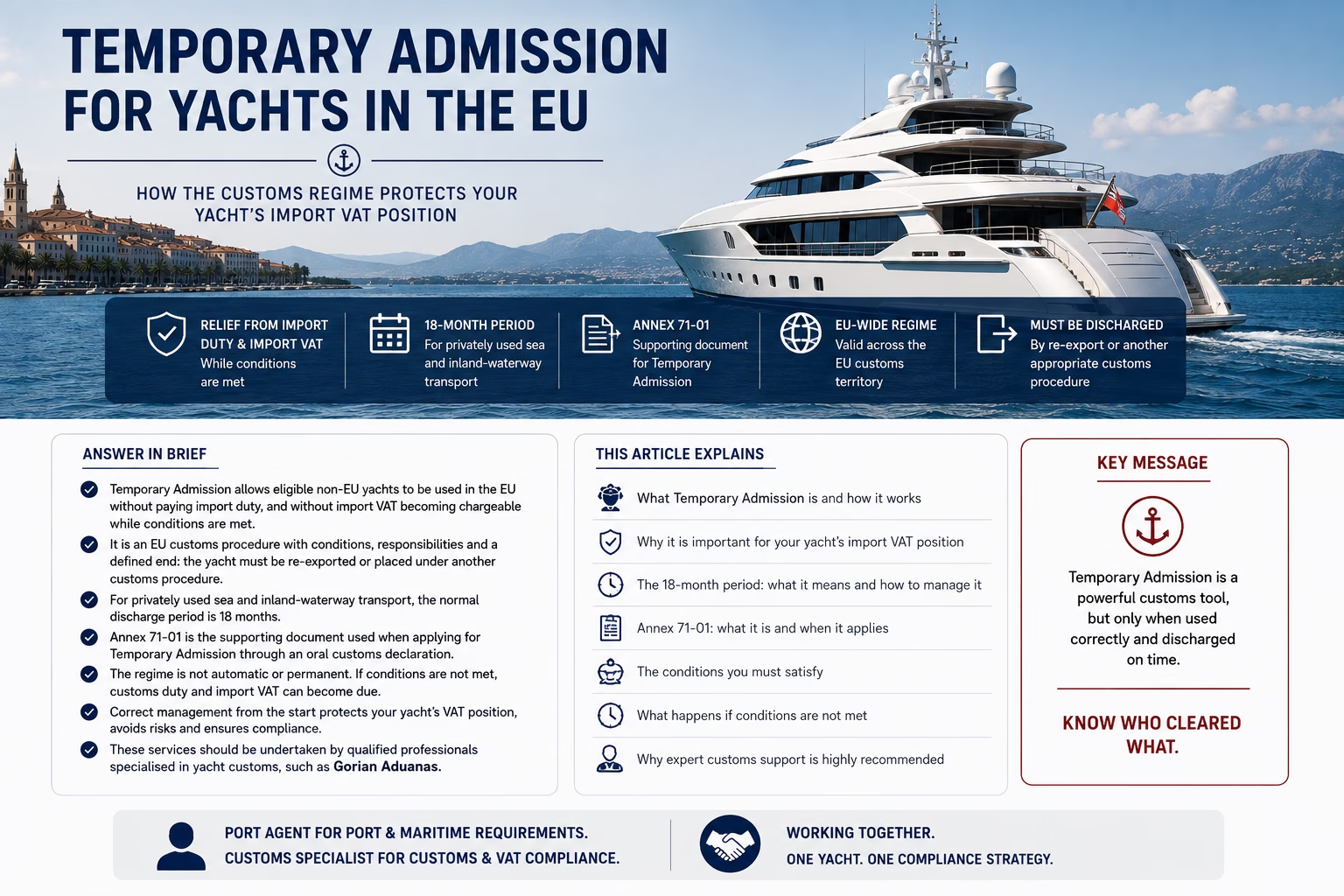
Temporary Admission (TA) is an EU customs procedure that can allow an eligible non-Union yacht to be used in EU customs territory without immediate import duty and, while the conditions are met, without import TAX / VAT becoming chargeable.
Temporary Admission for yachts into Europe is conditional, not an automatic or permanent VAT / TAX exemption. The yacht must meet the applicable customs requirements throughout the procedure. For privately used sea and inland-waterway transport, the normal discharge period is 18 months, making deadline management an important part of compliance.
Annex 71-01 is the supporting document associated with the customs declaration process for any Yacht or vessel Temporary Admission where applicable.
At the end of a Yachts Temporary Admission, customs clearance professionals specialising in the nautical sector such as Gorian Customs Clearance must ultimately discharge that yacht, normally through re-export or by placing the yacht under another appropriate customs procedure. The yacht’s customs and TAX / VAT position should be supported by proper documentation, evidence and monitoring from entry through to discharge by experts in this field.
Because yacht customs and TAX compliance can involve significant financial consequences, it is highly recommended that the required customs formalities and compliance work are handled by qualified customs professionals with specific yacht experience, such as Gorian Aduanas customs agents.
Temporary Admission and the Annex 71.0 are customs procedures, not simply a permission to keep a yacht in the EU for 18 months. Know the procedure, the conditions, the deadline and who is responsible for managing and maintaining it.

When a non-EU yacht enters the European Union or one of its member such as Spain, France or Italy, there are several different legal and operational questions that can arise.
- Where is the yacht arriving?
- Who is on board?
- Has the vessel completed its port and maritime formalities?
- Have immigration requirements been dealt with?
And, critically:
- What is the yacht’s customs status?
For an eligible non-Union yacht intended for re-export, Temporary Admission is the EU customs clearance procedure that can allow a yacht to be used within the customs territory of the Union with total or partial relief from import duty and tax, provided the applicable conditions are satisfied and maintained.
This is established in Article 250 of the Union Customs Code (UCC). The UCC sets out the fundamental conditions of Temporary Admission for yachts, including the requirement that the goods are intended for re-export and, subject to the applicable rules. That the holder of the procedure is established outside the customs territory of the Union.
That distinction matters.
Temporary Admission is not simply a label attached to a yacht after it has arrived in a marina.
It is a customs clearance procedure with conditions, responsibilities and a defined end point that must be adhered to.
As you may have guessed, the most important issue for many non-EU yacht owners or yacht captains is not the customs duty alone.
It is the import TAX / VAT.
Normally, VAT or TAX becomes chargeable when goods are imported into the EU. However, Article 71 of the EU VAT Directive provides specific rules for goods placed under certain suspensive customs arrangements, including temporary importation with full exemption from import tax.
In those circumstances, the VAT chargeable event is deferred until the goods cease to be covered by the relevant arrangement, subject to the applicable rules.
This is why it is so important that the correct Temporary Admission is applied by qualified professionals in customs clearance to ensure that the tax has been addressed and suspended formally during the yachts visit, and both owner and captain are confident of the process.
While the yacht remains correctly covered by the regime and its conditions continue to be met, the owner does not simply treat the yacht as an ordinary import on which EU import VAT must immediately be paid.
But there is an important qualification:
Temporary Admission is conditional.
It is not the same thing as permanently importing a yacht without VAT / TAX.
The yacht remains subject to the customs procedure and must eventually be re-exported or placed under another appropriate customs procedure. If the conditions cease to be met, customs duty and VAT consequences can arise.
The European Commission’s guidance for private boats states that non-EU vessels intended for re-export may be temporarily brought into and used for private purposes in the EU customs territory without customs duties or VAT needing to be paid while the conditions of Temporary Admission are met.
It also makes clear that the procedure must ultimately be discharged. That is the principle yacht owners and captains need to understand.
Another important point is that Temporary Admission is not a Spanish only procedure.
A yacht is placed under the EU customs regime, meaning the relevant customs territory is the customs territory of the Union, rather than a separate Temporary Admission period being created independently every time the yacht moves from one EU Member State to another.
The European Commission’s private boat guidance specifically explains that a yacht is temporarily admitted into the EU customs territory rather than separately into each Member State.
This is particularly important for yachts and other vessels.
A yacht may enter through Spain, continue to France, Italy or another EU Member State, and still remain within the same EU customs framework.
But that freedom to move within the customs territory should not be confused with freedom from EU or a countries customs obligations.
The yacht remains subject to the conditions of the procedure set out by the qualified customs clearance professionals such as Gorian Aduanas who specialise in the nautical sector.
Temporary Admission is not available simply because a yacht is registered outside the EU.
The customs legislation establishes conditions that must be satisfied.
Article 250 of the Union Customs Code provides, among other things, that:
the goods must be intended for re-export;
they must not be intended to undergo changes other than normal depreciation resulting from use;
the goods must generally be identifiable;
the holder of the procedure must generally be established outside the EU customs territory, unless an exception applies; and
the relevant conditions for total or partial relief from import duty must be satisfied.
For means of transport, additional conditions apply under the Commission Delegated Regulation.
The rules cover matters such as registration outside the Union customs territory, ownership or control, and the circumstances in which the means of transport is used.
This is a novice error to why a blanket statement such as “It’s a non-EU yacht, so it automatically gets 18 months in the EU” is not an adequate customs assessment.
The facts surrounding the yacht matter.
The registration matters.
The owner or holder matters.
The intended use matters.
The correct documentation and customs clearance matters.
And the way the yacht is brought under Temporary Admission matters.
The “18 month period” is one of the most important rules for privately used yachts its owners and captains of these yachts.
Article 217(e) of Commission Delegated Regulation (EU) 2015/2446 establishes an 18 month discharge period for privately used means of sea and inland waterway transport under Temporary Admission.
The European Commission’s guidance for private boats confirms the same principle: the normal period for a privately used yacht under Temporary Admission is one and a half years — 18 months.
But it is important to use the terminology correctly.
The 18 months is not simply a general “EU cruising allowance.” It is the period associated with the yacht’s discharge from the Temporary Admission procedure and thus the EU.
In practical terms, the yacht must ultimately be:
That distinction becomes extremely important as the deadline approaches, and our experience shows that government customs authorities are becoming ever increasingly stricter that this period is NOT VIOLATED.
We have many case studies of actual situations where our services were requested by a captain or owner of a yacht who have over stayed the 18 month period and consequently been presented a TAX / VAT liquidation summons for 21% of the value of the yacht by the countries customs authorities.
A yacht owner or captain should not think of the 18 month period as something that can simply be ignored until the final week.
The customs status should be monitored from the beginning.
The owner or captain should know:
when the yacht was placed under Temporary Admission;
what evidence supports that customs position;
what the applicable discharge deadline is;
what circumstances could affect continued eligibility;
what evidence will be required to demonstrate discharge; and
what action will be taken before the deadline.
Teses are all specialities and qualities that the a qualified customs clearance agent like Gorian Aduanas should be controlling from the start. This is why we stand by our argument that a yacht owner and yacht captain must distinguish the different professional roles required to assure that the vessels TAX / VAT is not subject to liquidation. The customs clearance professionals who ONLY deal with the customs authorities day in and day out are not to be confused with the services that a yacht agent can offer.
Generally speaking a yacht agent CAN NOT make customs declarations to the customs authorities un less qualified and authorised to do so by the competent authorities!
Any errors in a customs declaration made by an unqualified or inexperienced person will cause the owner to be responsible.
The Union Customs Code provides a general framework under which customs authorities determine the period for discharge, while Article 217 provides the specific 18 month period for privately used sea and inland waterway transport.
Exceptional extensions can exist in certain circumstances, but they should not be treated as an automatic right or as part of the normal planning strategy. Article 251(3) of the UCC –
allows customs clearance agents like Gorian Aduanas to liase with customs authorities to seek an extension in exceptional circumstances where the authorised use cannot be achieved within the applicable period and a justified application is made.
In other words:
In the nautical world it is perceived very bad practise and an unnecessary risk to your TAX suspension to plan your yacht’s customs position around an extension that is arbitrary and may not receive.

Yacht owners and captains will often encounter the term Annex 71-01 when dealing with a Temporary Admission for Yachts in the EU.
An annex 71-01 is an EU customs document associated with the supporting documentation for goods declared orally for Temporary Admission.
Article 165 of Commission Delegated Regulation (EU) 2015/2446 provides that where an oral customs declaration is considered an application for Temporary Admission, the supporting document – Annex 71-01 – is to be presented also.
For yacht owners, the important point is not the terminology itself, but that there should be a properly established customs position and appropriate evidence of it.
A yacht owner, in every moment, must be able to establish and defend clearly what customs procedure the vessel is under, who handled it, what information was provided and what obligations remain during the permitted period.
This is increasingly important if the yacht later moves between EU Member States and customs authorities or when a different professional becomes involved.
This distinction deserves particular emphasis.
It is tempting to describe Temporary Admission as a way of bringing a yacht into Europe “VAT or TAX free”, but that wording is far too simplistic.
Correctly executed by authorised customs clearance agents like Gorian Aduanas, Temporary Admission for yachts can provide relief from import duty and, under the relevant VAT / TAX rules, can mean that import VAT is not currently chargeable while the yacht remains correctly covered by the applicable temporary import arrangement.
But the VAT / TAX relief on the yacht depends on the customs conditions continuing to be satisfied.
If the yacht ceases to qualify, remains in the EU beyond the applicable period without an appropriate solution or treatment, or otherwise fails to comply with the procedure, customs and VAT consequences can arise.
The European Commission expressly warns that if a privately used boat does not leave the EU before the relevant period ends, customs duty and TAX become due.
That is why Yacht VAT compliance should be treated with a qualified and authorised customs professional as part of the yacht’s wider customs strategy and security — not by a port agent or yacht agent as a separate accounting issue that can be dealt with later.

This is another important area where owners should avoid assumptions or advice from non customs orientated professionals.
A yacht may need maintenance, repairs, refit work, technical intervention or other services while in Europe and Spain. The existence of the yachts Temporary Admission or annex 71.01 DOES NOT mean that every activity carried out on or around the yacht automatically has the same customs or TAX / VAT treatment.
The customs clearance status of the yacht, the nature of the work, the goods involved, where those goods come from, how they enter the customs territory and how they are subsequently treated can all matter.
The European Commission’s 2026 Pleasure Craft Guidance was specifically developed to improve the uniform application of customs and tax legislation to pleasure craft across the European Union. It also emphasises that the guidance itself is explanatory and that the underlying legislation takes precedence.
For a high value yacht, where the TAX / VAT suspension can run into the tens of thousands, this is precisely where a customs clearance specialist with strong nautical experience and knowledge like Gorian Nautical Customs Clearance should become involved.
A refit project can involve much more than the yacht itself. There may be imported parts, equipment, replacement items, consumables and other goods entering Europe separately from the vessel. Each may have its own customs and VAT treatment.
This is perhaps one of the most important concepts in the entire article that should not be ignored.
Temporary Admission of a yacht or any other nautical vessel has an end.
The yacht does not simply enter the European Union under Temporary Admission and then remain indefinitely because nobody has raised an objection or “chased” them out.
The procedure must be finalised and closed correctly.
The normal way for a yacht under Temporary Admission to be discharged is re-export from the customs territory of the Union, although other appropriate customs outcomes may exist depending on the circumstances at the time of closure.
The European Commission explicitly describes re-export as the usual way of ending or discharging Temporary Admission for private boats.
This is why customs clearance is not a single event. It is a process that may need accompanying throughout the yachts stay in Europe or Spain.
There is an clearly established and defendible entry position.
There is a period during which the yacht remains under the customs regime.
There are conditions to be met and maintain.
Any alterations in the yachts circumstances that may effect the applied customs clearance solution are communicated to the customs professionals for analysis BEFORE actions are taken by the owner or captain of the yacht or vessel
And there is an eventual closure / discharge from the European territory.
That is fundamentally different from simply arranging a yacht’s arrival into a port or supplying provisions that a yacht agent is prepared to handle.
The professional yacht owner or captains approach is to maintain a clear customs file for the yacht at all times and at each and every entry and exit.
Depending on the yachts circumstances, that may include evidence relating to:
the yacht’s registration;
ownership and the relevant parties;
the yacht’s identification;
the customs procedure that was realised;
Temporary Admission documentation, Annex 71-01 documentation completed by Gorian Aduanas
the date and place of entry;
relevant customs communications;
supporting evidence concerning the yacht’s movements;
documentation relating to re-export or discharge; and
documentation of any items being brought aboard that may have required separate customs clearance and treatment to the yachts;
documents concerning any significant customs-sensitive activity during the period.
The exact documentation required will depend on the complexity of the yachts import circumstances and the customs procedures involved.
The principle is simple:
If the yacht’s customs position matters, engage the services of a qualified and authorised customs clearance professional with specialised nautical knowledge and keep evidence of that position.
Do not rely solely on feedback from non customs qualified person or solely on someone’s recollection or supposition that the yacht was “cleared” for everything.

We offer fully integrated customs clearance and VAT strategies for yachts of all sizes, from small recreational boats to yachts and large luxury vessels, we can provide import / export customs clearance, official customs paperwork, consignee solutions, temporary imports etc.
Our headquarters are located close to the Port of Málaga, a key point of entry for both Mediterranean and Atlantic-bound vessels. But our reach extends far beyond the Costa del Sol.
We operate across all of Spain and throughout the European Union, supported by a trusted network of international collaborators that allow us to deliver solutions wherever you need them seamlessly.
We adapt to each client’s needs and vessel type, crafting bespoke customs and VAT solutions that are as unique as your yacht.
Whether it’s a permanent import, temporary admission, or managing VAT Exemption for Charter Yachts and Recreational Boats or commercial charter fleets, we make the process seamless.

This is where this article connects back to the central message of this 3 part series.
Part 1 – Part 3
the correct yacht agent can be extremely valuable in coordinating the practical and operational requirements surrounding a yacht’s arrival and day to day.
A qualified and authorised customs clearance specialising in yachts and the nautical sector as a whole has a different responsibility altogether and should not be underestimated.
The yacht agent manages the yachts onboard and port side requirements.
Gorian authorised customs clearance specialists manage the official customs position of the yacht upon entry into the EU.
Both professionals can — and often should — work together. When tuned in harmony, this should inevitably offer the yacht owner and captain a 360 degree support package centred around professionals qualified and experimented in their own specialities.
The objective is never to create another layer of administration. The objective is to ensure that the yacht’s customs position is understood by someone whose speciality is not only customs clearance but NAUTICAL / YACHT CUSTOMS CLEARANCE.
For an owner or captain, one of the most useful questions to ask is therefore:
What TAX exemption / suspension does the yacht have or who is responsible for the yacht’s Temporary Admission and import VAT position as it stands?
If the answer is unclear, that is the point at which the customs clearance position should be reviewed by a professional and the sooner the better.
Gorian Aduanas – specialists in complex yacht and nautical customs clearance issues can offer a consultancy review of your yachts exposure and customs position for a small one time consultancy fee. Enquire here.
Before the yacht arrives, there should be someone engaged who can offer you answers to the following:
Do not assume that non-EU registration alone answers the question.
Identify the customs professional responsible.
Make sure the answer is clear and documented, not just brushed aside or put off for a later date.
For privately used sea and inland waterway transport under the relevant Temporary Admission rules, the normal period is 18 months. That is YOU MUST HAVE CLOSED AND LEFT BEFORE THIS PERIOD EXPIRES.
Do not rely only on verbal confirmation alone.
This should be considered before the deadline becomes a problem, and a customs clearance agent should be involved to help communicate and resolve the issue with the authorities.
Important Note:
The exit strategy should be understood from the beginning. In our opinion, any professional who does not plant the question or at least touch on the subject at the beginning, upon entry and opening the temporary admission for the yacht is lacking the nautical experience an owner should be striving for.
These are not unnecessary questions.
For a yacht with a substantial customs and TAX / VAT exposure, they are basic risk management questions that should be standard practise for any yacht owner and captain.

Temporary Admission for yachts can be one of the most important customs clearance mechanisms available to an eligible non-Union yacht entering into Europe.
It can allow the yacht to be used within Spain and the EU customs territory without the immediate payment of import duty and, while the relevant conditions remain satisfied, without import TAX / VAT becoming chargeable.
But it is not an automatic VAT / TAX exemption.
It is not simply an 18 month cruising pass.
And it is not something that should be assumed because a yacht has completed its port arrival formalities.
It is an EU customs procedure with eligibility requirements, conditions, a defined discharge period and consequences if those requirements are not respected.
For privately used yachts, the allowed discharge period is 18 months. That period should be treated as the customs deadline of the yacht that needs to be understood and managed.
The safest approach is therefore straightforward:
Know the yacht’s customs status.
Know that an authorised customs professional is responsible for it.
Know the deadline.
Know the requirements and obligations,
Know how the procedure will be discharged.
And above all:
Know who cleared what.
Temporary Admission is an EU customs procedure that can allow eligible non-Union goods intended for re-export, including qualifying yachts and nautical vessels, to be used in the EU customs territory with total or partial relief from import duty / import TAX – VAT, subject to the applicable conditions.
For privately used means of sea and inland waterway transport, the specific closure / discharge period is normally 18 months under Article 217(e) of Commission Delegated Regulation (EU) 2015/2446.
Not in the sense of a permanent VAT exemption. While the yacht remains correctly covered by the relevant temporary import arrangement, import VAT may not become chargeable. If the conditions are breached or the procedure is not properly discharged, VAT and customs consequences can arise.
No. Temporary Admission is an European customs procedure applying within the customs territory of the Union. A qualifying yacht is not normally given a completely new Temporary Admission period simply because it moves between Spain and Italy or France.
What is Annex 71-01 for a yacht in Spain or Europe?
Annex 71-01 is an EU customs document associated with goods declared for Temporary Admission. Article 165 of the Commission Delegated Regulation provides for its use together with an application for Temporary Admission.
The owner or captain should ensure that a licensed professional with appropriate customs expertise like Gorian Customs Clearance is responsible for securing the yacht’s customs position.
NO, not in general practice unless the yacht agent is working directly with Gorian Customs Clearance and instructed by the yacht owner or captain.
A yacht agent or consignee may coordinate port, maritime and operational formalities, but customs clearance and Temporary Admission are customs matters and only authorised customs agents can work with the Spanish customs authorities.
It is the responsibility of the owner or captain to establish specifically who is responsible for opening the yacht’s customs position and ensure that the yacht agent has engaged the services of a customs professional.
Also, it is very important that the owner is given the supporting documentation and evidence that the work has been carried out effectively for his records and any incidents or inspections that may arise during the stay in the EU.
The yacht must have its Temporary Admission procedure properly closed and discharged or be placed under another appropriate customs procedure by an authorised customs clearance agent. If the yacht remains under the procedure beyond the applicable period without a lawful solution, customs duty and VAT can become due payable by the authorities.
The UCC allows customs authorities to grant an extension in exceptional circumstances where the authorised use cannot be achieved within the applicable period, following a justified application.
Only under exceptional circumstances, the communication with the authorities and process needs to be undertaken by an authorised customs clearance representative and should not be considered as a guarantee, treated as an automatic extension or as something to rely on for routine planning.
Continue Reading Part 3 →
Related Gorian Articles
Existing detailed guidance:
Importing Yachts and Vessels Using Annex 71-01 into Spain – Temporary Admission
Existing detailed guidance:
Temporary Admission for Non-EU Yachts in Spain – Annex 71-01 and VAT Compliance
Existing detailed guidance:
Customs Clearance Annex 71-01 for Yachts in Spain – Documentation, Compliance and Common Mistakes
Thank You for reading
Source: Gorian Aduanas
July 6, 2026
| Cookie | Duration | Description |
|---|---|---|
| cookielawinfo-checkbox-analytics | This cookie is set by GDPR Cookie Consent plugin. The cookie is used to store the user consent for the cookies in the category "Analytics". | |
| cookielawinfo-checkbox-functional | The cookie is set by GDPR cookie consent to record the user consent for the cookies in the category "Functional". | |
| cookielawinfo-checkbox-necessary | This cookie is set by GDPR Cookie Consent plugin. The cookies is used to store the user consent for the cookies in the category "Necessary". | |
| cookielawinfo-checkbox-others | This cookie is set by GDPR Cookie Consent plugin. The cookie is used to store the user consent for the cookies in the category "Other. | |
| cookielawinfo-checkbox-performance | This cookie is set by GDPR Cookie Consent plugin. The cookie is used to store the user consent for the cookies in the category "Performance". | |
| viewed_cookie_policy | The cookie is set by the GDPR Cookie Consent plugin and is used to store whether or not user has consented to the use of cookies. It does not store any personal data. |
Hablenos por WhatsApp!
Registered in – Malaga, Spain
Offices not open to the public.